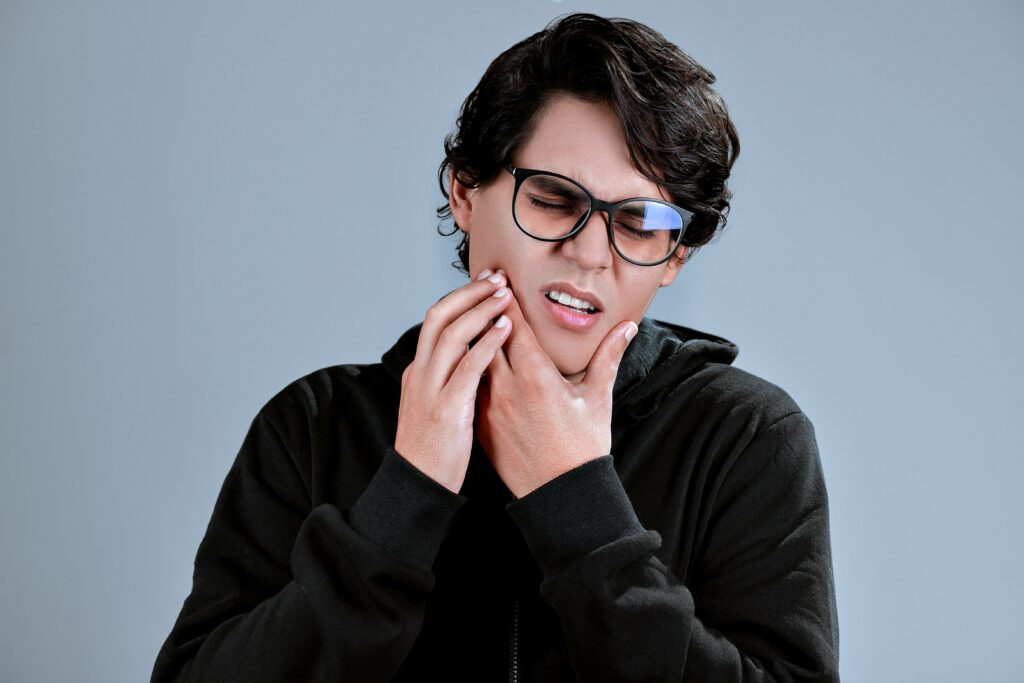
Have you ever felt a big ‘click’ or ‘pop’ as you have opened your jaw? and wondered why does my jaw click? This is a common occurrence as up to 70% of the population will experience a dysfunction of the jaw at some point in their life. Good news is that it’s also very treatable by a health care practitioner such as an Osteopath.
Anatomy
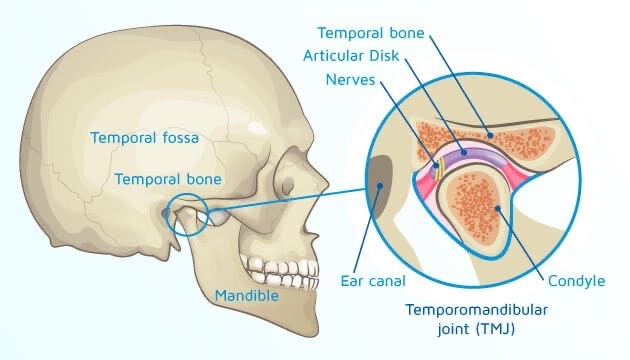
The jaw is made up of the temporal bone and the mandible bone. Together they make up the temporo-mandibular joint (TMJ). There is a small articular disc which divides the two bones up and provides a smooth fluid movement at the joint. There are ligaments around the jaw which provide stability. The discomalleolar ligament arises from the smallest bones in your body (within the middle ear). If these ligaments get damaged, this will often lead to tinnitus or other inner ear conditions. That’s why there is a big link between ear dysfunction and jaw pain.
Muscles of the Jaw
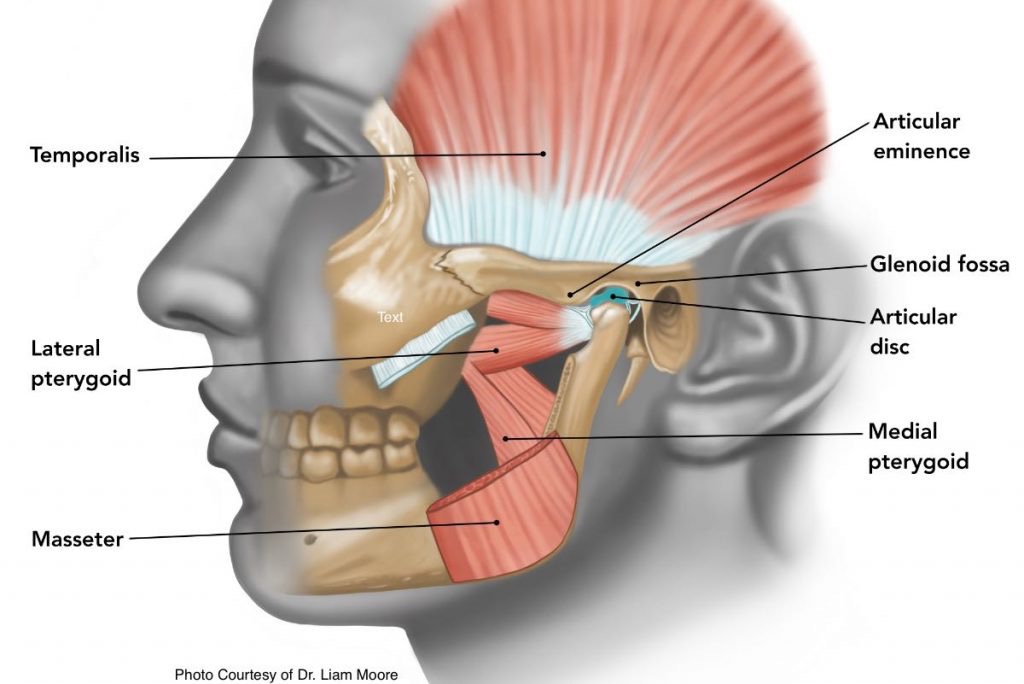
There are many different muscles that attach to the jaw and allow movement in many directions.
Closing – Masseter, medial pterygoid, anterior and middle temporalis, superior head of lateral pterygoid
Opening – Inferior head of the lateral pterygoid, mylohyoid and digastric muscle, eccentric contraction of closing muscles against gravity
Protrusion (gliding jaw forward) – Lateral pterygoid
Retrusion (gliding jaw back) – Middle and posterior temporalis
What is that clicking sound?
There are many reasons why the jaw can cause the clicking or popping noise. The most common causes are:
- Bruxism (teeth grinding/clenching)
- Arthritis
- Articular Disc displacement
- Stress
- Trauma
Treating these underlying issues can help get your jaw moving well with no pops or clicks!
How can an Osteopath help?
Using a variety of soft tissue techniques, we can release the tight muscles around the jaw and create more space within the joint capsule of the TMJ to allow greater ease for the articular disc to move when opening and closing your mouth.
An Osteopath may also treat the cervical spine, as many muscles attach to both the jaw and neck. This is often why people who suffer from headaches are more likely to experience jaw pain.
Osteopaths treat holistically and you as an individual not just where the pain is or your condition. So each treatment will vary between individuals even with the same injury.
Check out Ellie’s profile on the meet our team page to learn more about her.